We decided that for this edition of Years Ago we would look at Crime as a topic. We have looked at the first 3 months of the years 2001, 1951 and 1871. The definition of a crime is a fact, a matter of law, and an act deemed illegal and punishable.
There are, as we expected, differences in how the stories have been reported and indeed whether they have been reported at all. In the 19th Century papers we often find crimes such as swearing in the street covered, things that we would not even notice today. It is worth noting that although many of the stories on crime in 1870 seem trivial it was only low level offences that were dealt with at the local “Petty Sessions”. More serious offences were the preserve of the Crown Court and Transportation to Australia for many crimes was a regular Crown Court punishment until 1868.
2001
The overall crime rate in Devon as of Sep 2025 was 61 crimes per 1,000 people, and the most common crimes are violence and sexual offences
Precise crime figures for the Torridge area for the calendar year 2001 are not easily available. Some reports indicate that Torridge has historically had a low crime rate compared to national averages. For example, a 2019 report noted that between July 2018 and June 2019, the crime rate per 1,000 people in Torridge was 43.9, less than half the national rate of 89.5. To compare the national rates, we can see that crimes per 1,000 people in 2025 were 61 and in 2019 89.5 so taken at face value that appears to be an encouraging decrease.
In the first 3 months of 2001 reports in the Bideford Gazette are more likely to mention theft and burglary than violence.
Residents were warned to be careful when loading their car boot at the supermarket on 10th January 2001 it was reported that a handbag was stolen from the car when a shopper returned her trolley.

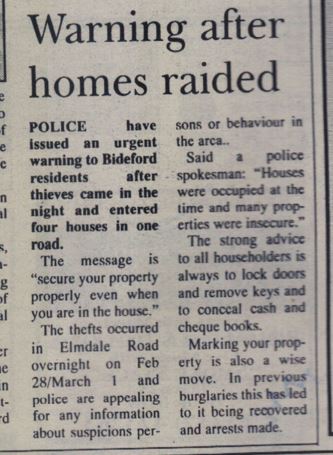
There is a disturbing story of burglars entering properties at night when people are in occupation. This report is from 7th March 2001 and police advice was to secure property carefully and mark belongings so that they can be traced. People are probably more security conscious today.
To continue the theme of marking property and due to the popularity of scooters and the ease with which they could be stolen, police introduced a scheme to postmark them.
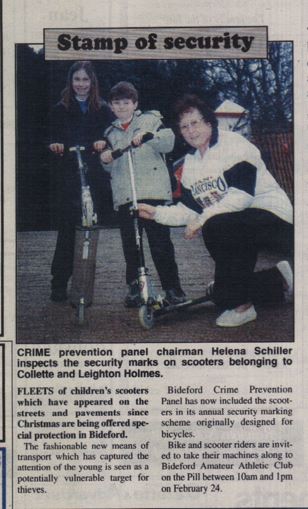
Reported on 31st January 2001
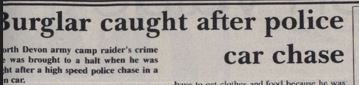
A sad tale was reported on 7th February 2001 telling of an arrest after a high speed car chase. At the court hearing a story of being driven to crime through homelessness following a row with his girlfriend emerged. He was living in his car and stole for food and clothing. He pleaded guilty to 5 burglaries, 3 offences of handling stolen goods, 3 of theft and one of aggravated vehicle taking.
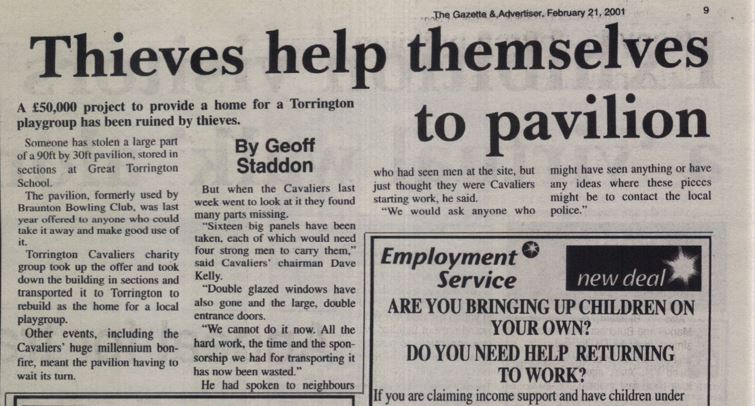
On 21st February an outrageous crime was reported. Torrington Cavaliers were in the process of moving a pavilion to be used to house a local playgroup. The project costing £50,000 was thrown into doubt when part of the dismantled building was found to have been stolen.
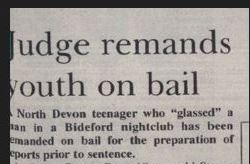
One incident of violence was reported on 7th February 2001. A Bideford young man was glassed at a nightclub. The guilty man was of previous good character and a report on suitable sentencing was ordered. The young man was allowed bail in the meantime but was told that this would not necessarily mean he would not receive a custodial sentence.
In 2001, England and Wales had a prison population of 68,127 including people on remand. The number of prisoners serving sentences for drug offenses had grown rapidly since 1993, reflecting increased court sentencing, a slightly higher proportion of those receiving custodial sentences, and longer average sentences. The total number of prisoners increased by 24% between roughly 2000 and 2021, a slower rate than the overall population growth. In June 2025, the prison population in England and Wales was around 87,334 including people on remand.
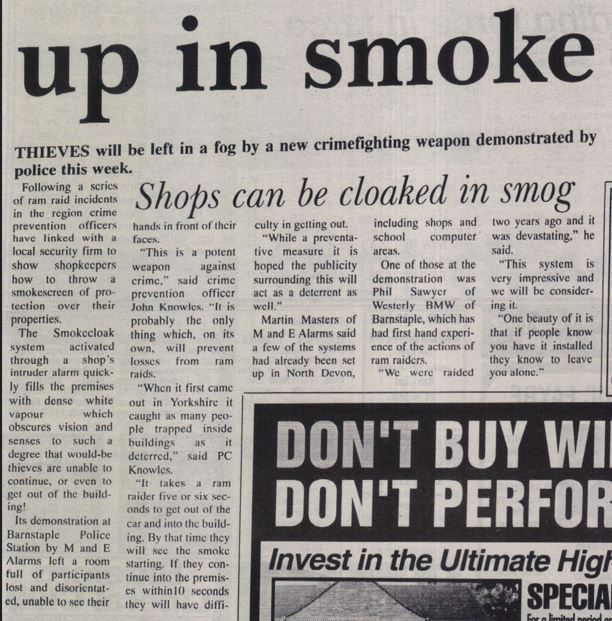
In January 2001 there were 2 stories showing police attempts to fight back against crime. On 24th there was a story showing a defensive measure against ram raiding. This crime was where a vehicle was driven into a target property and items stolen including, sometimes cash machines. Crime prevention police demonstrated the use of a smoke screen to disorient and deter thieves.
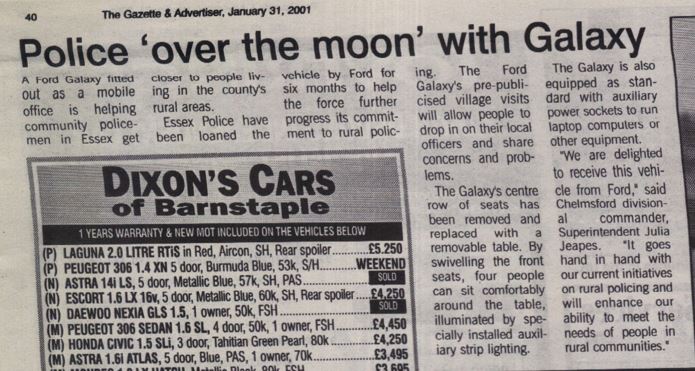
On 31st the Gazette reports a new idea, a Ford Galaxy fitted out as a mobile crime fighting office to help police in rural areas. A quick check on Google reports that such mobile police offices are still used by Devon and Cornwall police.
There are 2 reports that remind us of major problems that were preoccupying the country in 2001.
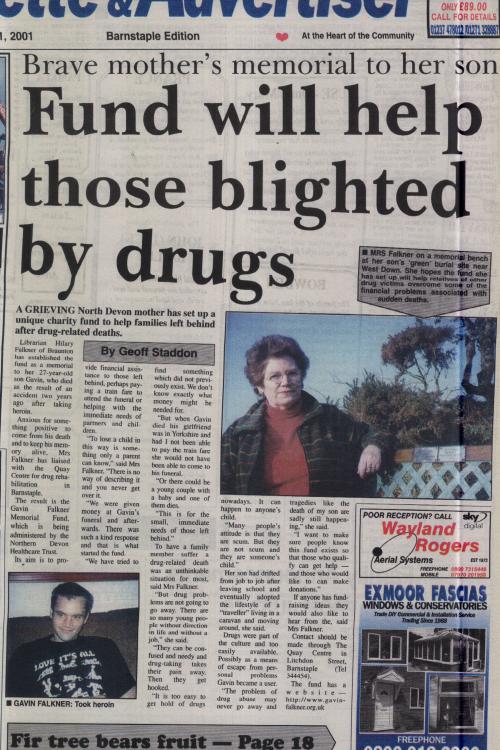
Firstly there is a report of a grieving mother setting up a fund from generous donations given at her son’s funeral to go towards the immediate expenses of those loved ones left behind. Drugs have become an ever increasing problem in our communities leading to crime, both organised and petty and blighting lives.
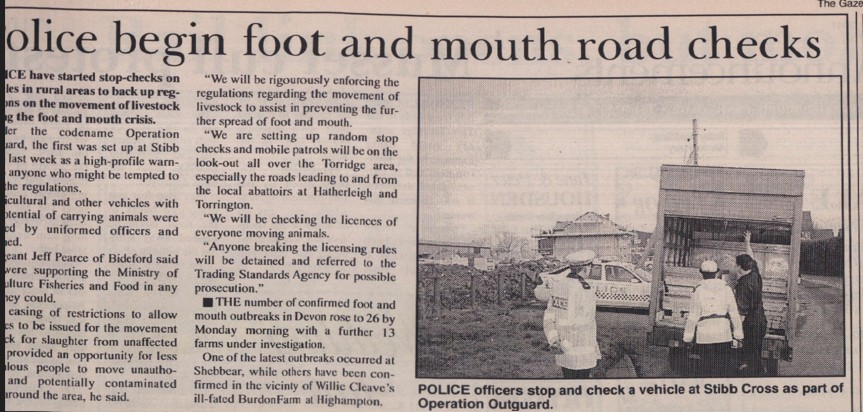
Secondly we are reminded of the horror of the foot and mouth epidemic that brought such heart ache and difficulty to our farming community. The movement of animals was banned and a report from 14th March 2001 shows the measures introduced to try to prevent the spread of the disease. It is hoped that behind the scenes measures are now being developed to prevent the need for widespread slaughter and incineration of valued animals.
1951
When World War II broke out, crime rates fell but rose during the Blitz as criminals took advantage of air raids to steal from homes, shops and even people killed, and with the war bringing in rationing this led to the theft and illegal sale of goods on the ‘black market’. As a consequence, the crime rate rose from 250 per 1,000,000 people in 1901 to 1,000 per 1,000,000 by 1950. The nation’s homicide rate was 4.6 per 1,000,000 population in 1950. In 1951, the number of indictable offences rose to over 500,000.
With social, political and scientific developments, new crimes have emerged and more liberal views means that punishments have changed significantly. For instance, it has been announced that the Vagrancy Act of 1824 will finally be scrapped this year and rough sleeping in and of itself will no longer be a criminal offence in the UK; local prison records show that between 1838 and 1852, 45 people were charged and sentenced for vagrancy. In another change it is now illegal to advertise for or hire based on gender, without a valid occupational requirement, as this is considered discrimination.
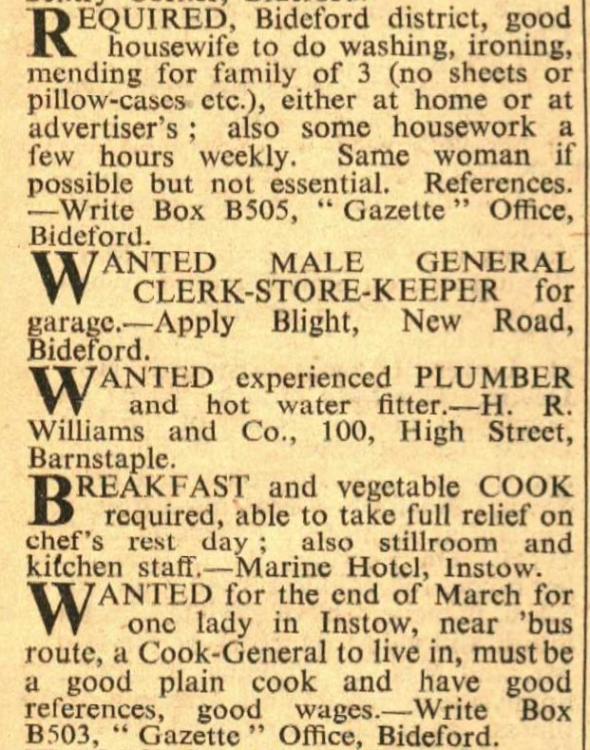
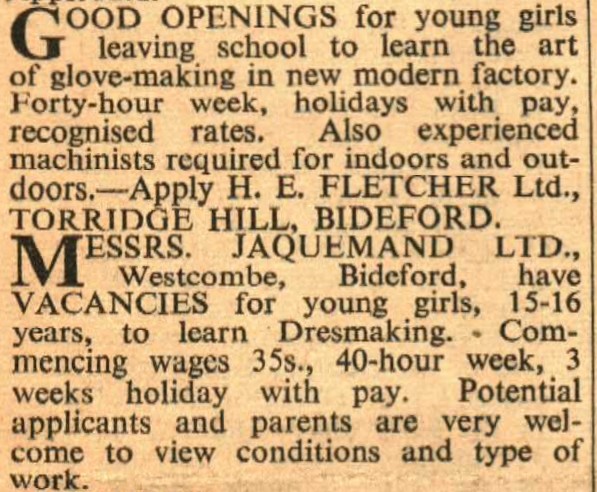
Adverts such as these from H E Fletcher Ltd, and Jaquemand Ltd would now not be acceptable - 2 February 1951.
Ration books and identity cards were still in operation in 1951, and for the first time since 1931, a census of the population was to be taken on April 8th.

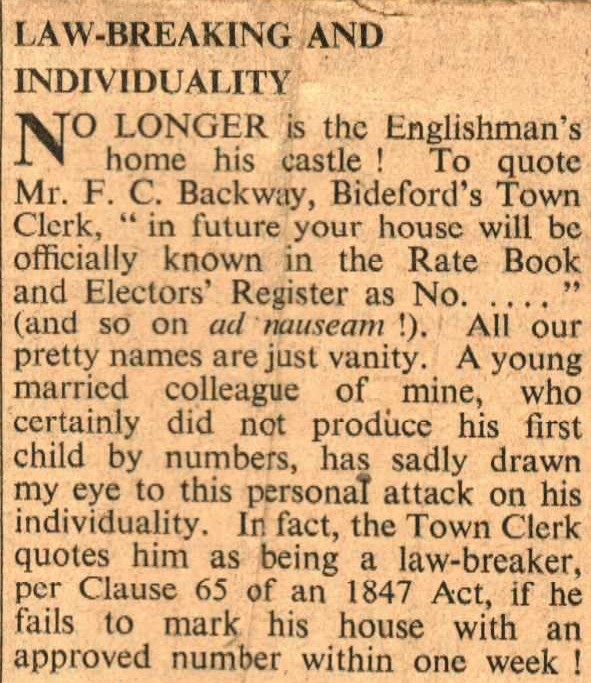
It pays not to be an individual! The Town Improvement Clauses Act 1847, Section 65 – provides authorities with the power to number properties and ensure occupiers affix approved numbers to buildings.
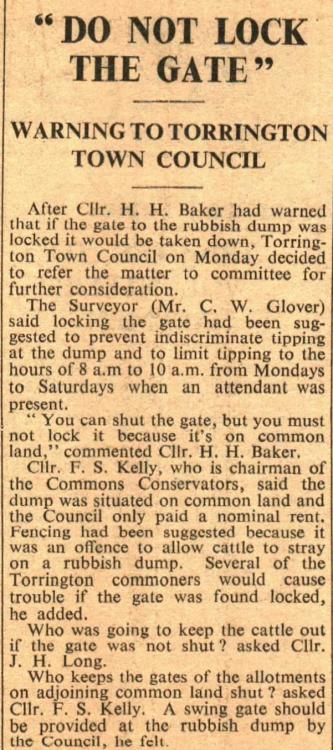
Reviewing historic newspapers makes you realise that, what we consider to be ‘modern day’ issues, are not necessarily so. For instance, in January 1951, Torrington Town Council advised that if a gate to the rubbish dump is locked to prevent indiscriminate tipping, it would be illegal because the dump is on common land, and ‘several of the Torrington commoners would cause trouble if the gate was found locked”.
Parents being fined for removing children from school was an issue in 1951. An Appledore man was fined £1 for keeping his son from school to carry out work, and, a Hartland man was found guilty of ‘failing to send his son to school on November 22nd and a number of previous occasions.” As mitigation, the defendant said that “he did not know that the certificate of exemption, which entitled the boy to a period of absence from school for agricultural purposes, had expired.”
Here is a Parliamentary exchange on this subject from 1953

Hansard (Volume 515: debated 21 May 1953)
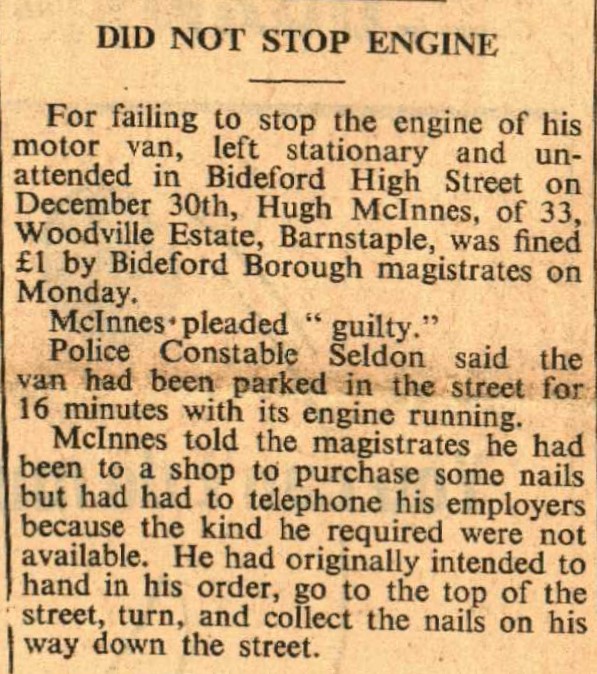
Some offences seem extremely minor but Hugh McInnes was fined £1 for failing to stop the engine of his motor van, leaving it stationary and unattended in Bideford High Street.
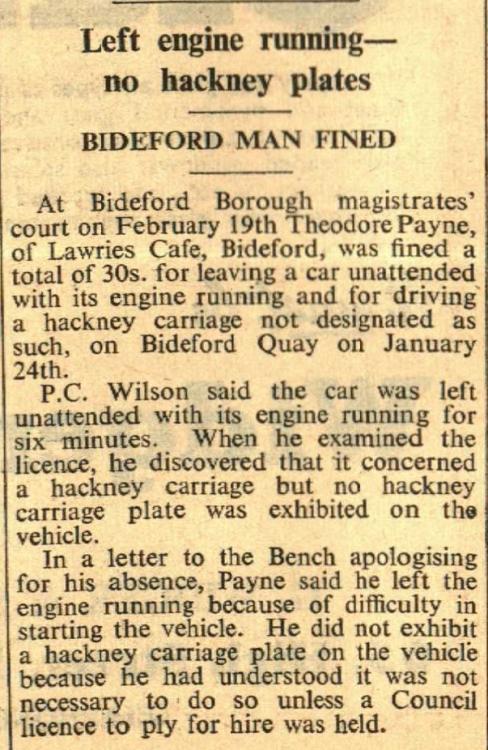
Hubert Hedley was fined £2 for causing an obstruction by parking his car in Bideford High Street – Police Constable Adams said during the 43 minutes that he saw the car parked it obstructed traffic, which was very heavy, on a number of occasions. Mr Payne, of Lawries Café, Bideford, is fined 30s for leaving a car unattended with its engine running and for driving a hackney carriage not designated as such.
Reported in March 1951 - "At the meeting of Bideford Town Council it was decided to supply twelve portable notice boards, at the request of the police. These boards will bear the words "Police Notice - No Parking" and are for use in High Street, Bideford."
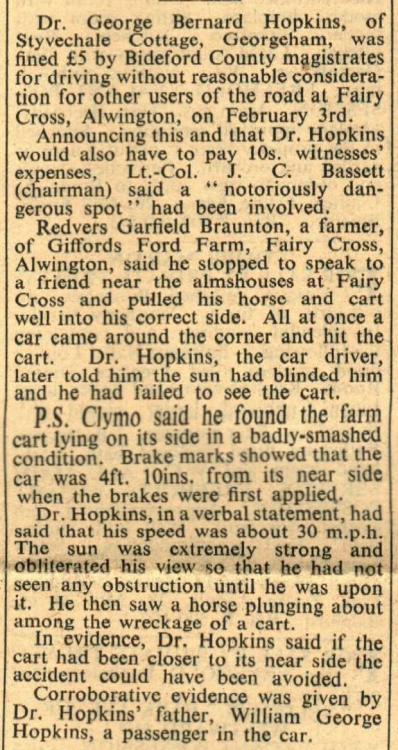
There were more serious offences reported, including that of Redvers Garfield Braunton, of Giffords Farm, Fairy Cross, Alwington, who was involved in an accident where his farm cart was badly-smashed.
“Sentence of twelve months’ imprisonment was imposed by Devon Quarter Sessions Appeals Committee, on …. of Barton Tors, Bideford. After a five-hour sitting, Bideford County magistrates had found …. guilty of stealing two ganders and three geese to the value of £15 from Landcross; tools to the value of £6 11s from Landcross; pyjama jackets valued at 10s each and a sheet valued at £1 10s from Torridge Laundry; and a green hand towel valued at 10s 6d from Bideford Black Pigments Ltd. His wife said “He has been a very good husband to me and good to the children. Whatever happened, I shall stick beside him.” She was much in love with him, she added. Mr Atkin, defending, said there must be some good in a man whose wife was willing to stand by him. The Chairman, Sir Leonard Costello: Some of the greatest villains in history have had such women. It is still more regrettable that he should have betrayed the trust his wife has in him.
A Bideford man and his mate who were involved in a night scene were fined for assault on police. The man, whose address is Bowden Green, Bideford, was fined £12 with 15s costs for assaulting and beating Police Constables Hemmens and Hughes. The Bench view this matter very seriously," said the Chairman. "They considered very seriously sending you to prison." The Chief Inspector said PC Hemmens found an altercation involving the two men, and in his effort to restore peace and quiet he was struck. PC Hughes went to his assistance. Damage was done to the wrist watch of one of the two men who went to help, and the car in which they were brought to the police station was damaged. The accused was alleged to have said: "I was drunk and that's that. I had no intention of hitting anyone and when the wine's in the wit's out."
Charged with the murder of his sweetheart, a farm pupil was found guilty but insane, and was ordered to be detained at Broadmoor during the King’s pleasure. The Crown alleged that he had strangled a girl from North Devon because they had to separate. The defence had suggested that he was suffering from a split-mind. In his summing up, the judge told the jury that if the true diagnosis was schizophrenia, then it was possible the accused had not known what he was doing and yet remember it afterwards.
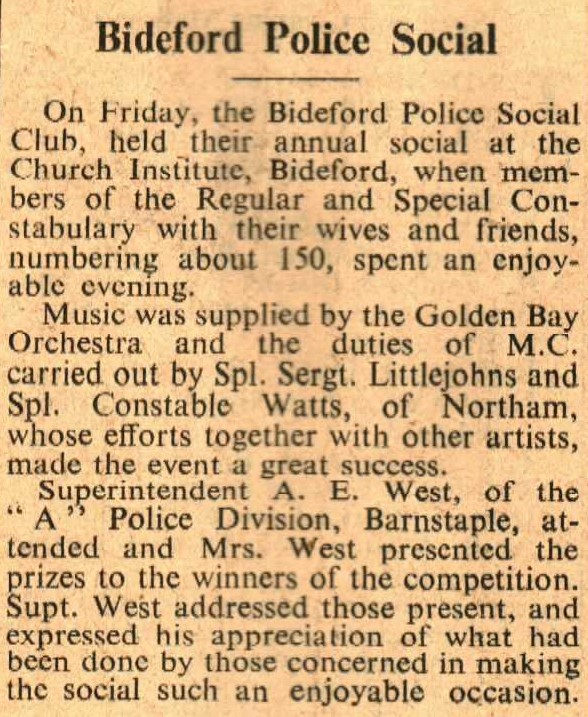
It’s not all doom and gloom and in January 1951, the Bideford Police Social is held at the Church Institute.
The annual Police Ball, organised by the Hoops Section, Devon Constabulary - Sgt Clymo, Constables W Tucker (Hartland) and Coldridge (Clovelly) - was held at the Church Hall, Hartland, on New Year's night, when there was a very large crowd present to dance to the music of Alec Blackmore and his band. The proceeds were in aid of the Devon Constabulary Widows and Orphans Compassionate Fund.
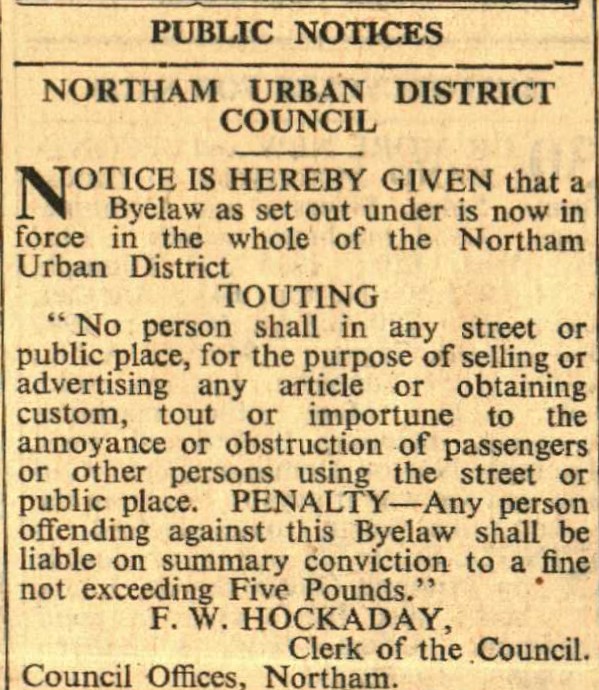
A by-law is a local law passed by a local authority or other approved body to regulate a specific area or activity, often for reasons of good government, public order, and preventing nuisances. These laws, which can require something to be done or not done, have the force of law and can include penalties like fines for non-compliance. In March 1951, Northam Urban District Council advises that any persons ‘Touting’ will be subject to a summary conviction.
1871
Interestingly 1876 was the first year that crime statistics were officially collected. In the early 1870s the most prevalent crime was petty theft making 75% of the total. Crimes of violence made up 10% of the total. It is difficult to compare these rates with modern statistics as they can only be taken as an outline of the true picture due to changes in many factors including, different descriptions of crime, lack of reporting, types of crimes changing - for example we do not have any examples of “hate” being a crime in 1870 or 1951 or domestic violence for that matter.
The newspapers for 1871 generally concentrate on national news with one page of the edition detailing local stories. There seem to be many ‘extraordinary’ cases to read about including the ‘Extraordinary Assault Case In Ireland’ (Poynter v Porter) took up column inches as did the ‘Extraordinary Case of Child Desertion’ and the ‘Extraordinary Robberies By Three Children.’
The Court System
There was a tiered system – Petty Sessions, Quarterly Sessions, Assizes.
A Borough Petty Session was the local court in English towns where Justices of the Peace (JPs) dealt with minor crimes, civil disputes, licensing and administrative matters without a jury and was the town’s equivalent to the county’s Petty Sessions. These sessions were informal and were crucial for providing accessible inexpensive justice for everyday issues and common problems. JPs sat in pairs or small groups (the ‘bench’), or singly, to judge.
A 1363 Statute directed that justices were to hold sessions four times a year, and in each county the quarter sessions were held in the main towns. During the 18th century, offences grew considerably and JPs referred increasing numbers of offenders to trial at the assizes.
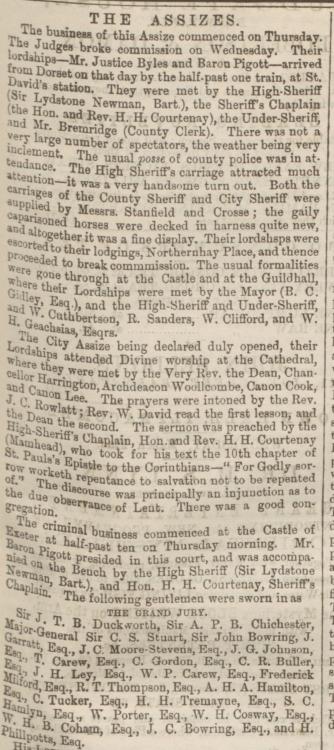
The courts of assizes were held twice yearly in the main county towns and presided over by visiting judges from the higher courts based in London. They conducted trials dealing with serious offences such as murders, burglars, rapists, forgers and others who came within the scope of capital crime. Verdicts were returned by locally picked juries of 12. These courts also dealt with civil disputes such as entitlement to land or money, and from the early 1900s, dealt with divorce cases. In March 1871, the Assize was held in the Castle of Exeter, with the event well publicised.
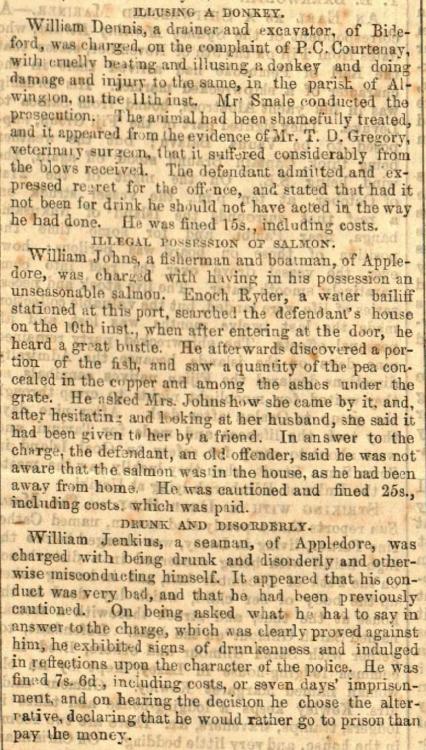
The following men were charged before the Magistrates, Captain Molesworth, RN, and Captain Pyke, RN, - William Dennis of Bideford; William Johns of Appledore; and William Jenkins, also of Appledore.
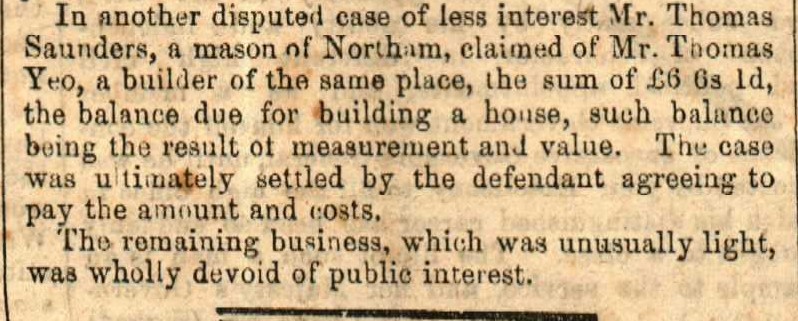
In Bideford County Court before Mr Sergeant Petersdorff, Judge, a cabinet maker and upholsterer, of Bideford, claimed the sum of £15 from builders and house decorators for an alleged breach of contract. The plaintiff is A Stone and the defendants, R Prior and Sons. Witnesses for both parties provided contradictory evidence; however the Judge considered that “the justice of the case would be met by deducting £1 from the account, and gave judgement for £14 with costs.” Mr Thomas Saunders and Mr Thomas Yeo are also in court:
Under Torrington news, a pugilistic-looking man, Richard Little, was charged before Mr A R Hole, under the Vagrancy Act with begging at Winscott. The charge was proved by Mr Moore-Stevens, the High Sherriff, who said: “while I was in my yard at Winscott, I saw the prisoner close to my back door, he came up to me and said he was in distress, and asked me to relieve him, I looked hard at him and thinking he was not an object for relief, I said to him, “You are the sort of man that ought to have three months’ hard labour.” He immediately bolted out of the yard and I followed him, and after a chase over my lawn I caught him. He was very violent and fought desperately, but with the assistance of some of my men he was taken to my wash-house, and detained there until the arrival of the police, who took charge of him. He refused to walk to Torrington and was obliged to be taken in a cart. Prisoner denied having begged and stated that he had been in the army and in India 11 years, and that he had received his discharge and was on his way from Bristol to Bodmin, but being out of money he met a companion at Bristol and they had agreed to travel together as dealers in rags, bones and rabbit skins. He called at Winscott, had inquired of the gentleman (Mr Stevens) if he had any rabbit skins but had never thought of begging. He was sentenced to three weeks’ hard labour.
Later that month, at the Borough Petty Sessions before Mr C Pedley (ex-Mayor) and Mr T L Pridham, Alfred Abbott and Joseph Heard, of Bideford, were summoned by Margaret Gregory, a prostitute living in Willett-street, for using obscene language towards her in the public streets. The two young men countersued for assaulting them at the same time and place. It was alleged that the language used on the occasion was very bad and that the assault was committed in self-defence, but the boys pleaded not guilty to the charge. After hearing the evidence the magistrate dismissed both cases, each party to pay their own costs.
Thomas Hoare, a tailor, is summoned by a lad named George Perkin …
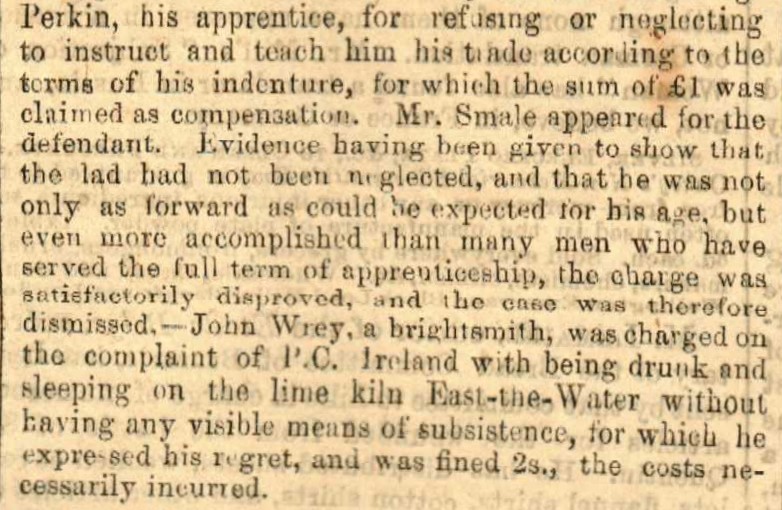
Also covered at the same time was a case against John Wrey.
Mr C Pedler, Dr Thompson, Mr T Evans and Mr T L Pridham also gave judgement on the following cases – Elizabeth Chope, charged for stealing two pairs of boots which were the property of Mr Prouse; Maria Daniel of the Steam Packet Hotel was summoned for keeping her house open for the sale of drink during prohibited hours; Captain Fishwick, master of the Lyndney Trader, was summoned by Captain Yeo, Harbour Master, for infringing bye-laws by disobeying his orders.
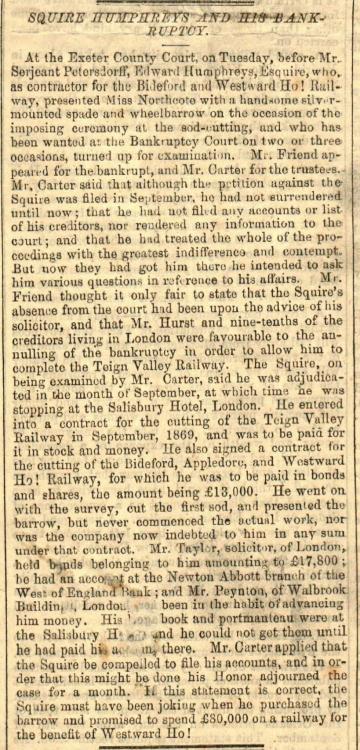
Mr Sergeant Petersdorff presided at Exeter County Court over the bankruptcy examination of Edward Humphrey, Esq, who was the contractor for the Bideford and Westward Ho! Railway.
Who was Charles Erdman Petersdorff? He was born in 1800 and called to the bar in 1833, and married Mary Anne Mallock, of Harley Street, London. Charles was appointed County Court Judge for Somerset and Devon in 1865. The title 'Sergeant' is officially known as Sergeant-at-Law and is a centuries old position. Charles died in 1886.
In January 1871, not all County Court sittings were worth reporting!
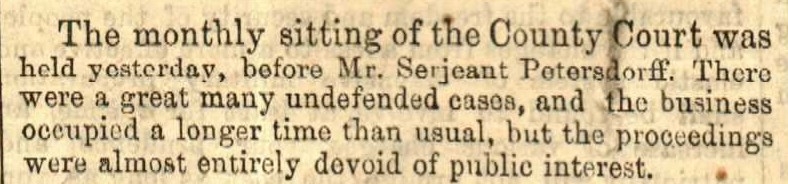
Later in the month, the reporter wrote “Bideford County Court – The monthly sitting was held but the business, although the cases were numerous, was of a trifling character, and wholly devoid of public interest.
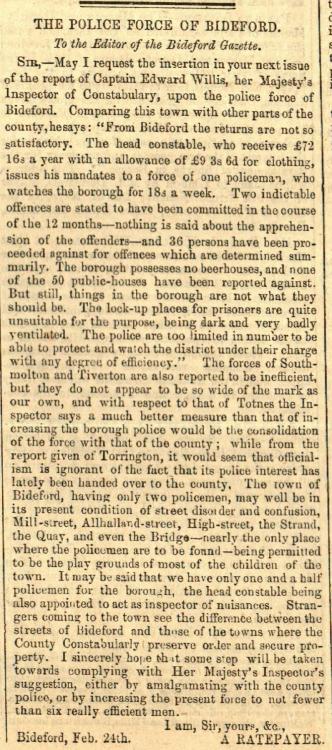
‘A Ratepayer’ expresses their concern about the efficiency of the reduced police force in Bideford.