Queen Victoria's death
Alexandrina Victoria, born 24 May 1819, was Queen of the United Kingdom of Great Britain and Ireland from 20 June 1837 until her death on 22 January 1901. She reigned for 63 years and 216 days.
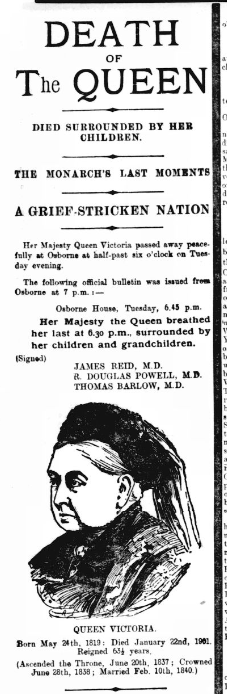
Why black borders on the newspaper?
This signified official mourning and was used by newspapers, government stationery and public notices to indicate that the nation was in an offical period of mourning. It was a symbol of bereavement and originated in Europe in the 17th century - "mounring stationery' which informed recipients of a death. Following the death of her husband, Prince Albert, in 1861, Queen Victoria establisehd long-lasting mourning traditions which included the use of black-edged papers to show reverence.
The course of the illness
“The condition of the Queen’s health at the close of last week gave cause for the gravest anxiety. Rumours of many kinds were in circulation, and on Friday night the official statements issues at Osborne showed that there was real cause for alarm. The first was from “The Court Circular,” and was in the following terms:
“The Prince and Princess of Wales, the Duchess of Argyll, and other members of the Royal Family left London on Saturday for Osborne, the Prince returning to the Metropolis on Sunday afternoon in order to meet the German Emperor and the Duke of Connaught on their arrival from Berlin. The Kaiser and their Royal Highnesses remained in London during the night. Prayers for the recovery of the Queen were offered throughout the land on Sunday.”
Daily bulletins issued
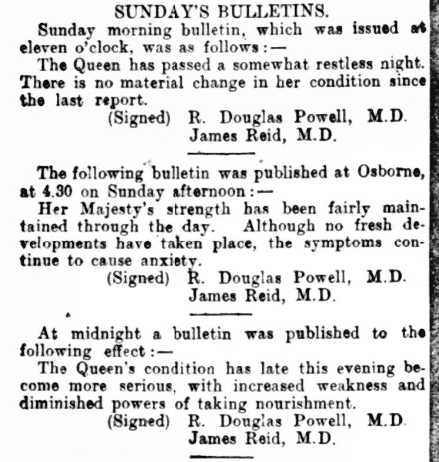
Sunday
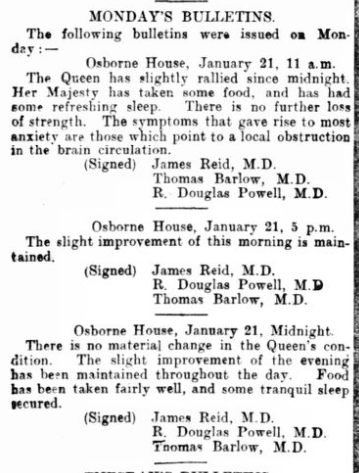
Monday
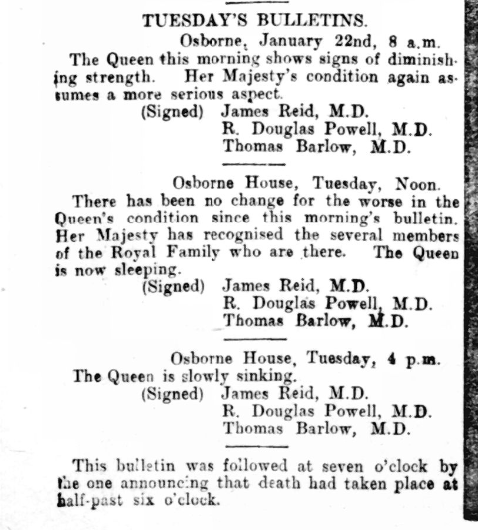
Tuesday
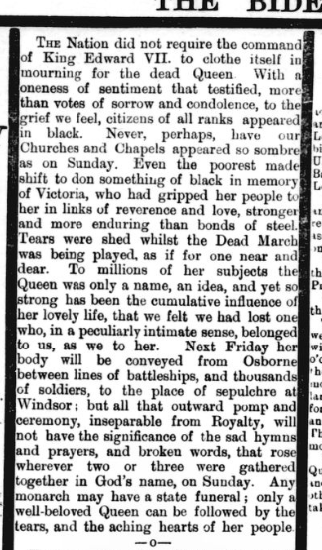
The Bideford Weekley Gazette and Devon and Cornwall Advertiser, Tuesday, January 29, 1901 - “The dreaded news of the death of our Queen reached Bideford shortly after seven o’clock, on Tuesday evening. At first people questioned the accuracy of the telegram, hugging a pathetic hope against hope that Her Majesty might yet be spared to continue her beneficent reign. But the first telegram speedily received confirmation, and Bideford reproduced scenes described in London, and indeed everywhere else within the Empire. Victoria’s people were dazed. A blow had fallen, the effect of which they could only dimly realize. The sign and symbol of England’s greatness has been struck down, the Mother of a great People had been taken from them, and they mourned with a grief all the more poignant and expressive because of its silence. The streets became hushed, shops were shut and business suspended, and through the brooding silence, ever and anon quivered the dull note of the passing bell. Presently a muffled peal rang out of the Church Towre, but its strident notes jarred on one’s nerves. One longed for quiet to think of the change involved, by the death of one lady, in all our National life.
Cause of death
"From a perfectly trustworthy source I have learned (says the special correspondent of the "Times") sundry details of her Majesty's illness, of which a part, at any rate, may be given without impropriety. For some months, until quite recently, the Queen has been suffering from the most wearisome of afflictions - sleeplessness; and signs that old age had come upon her were not absent. She lost her wonted activity. The wheel chair was used for the smallest movement. At Balmoral the sleeplessness became very troublesome, and it was hoped that the removal to Osborne, high and above the sleep-giving sea, would work wonders. It did do much, but it could not check the malady from which the Queen was suffering - a malady which some may call be the name of senile decay, while others are content to write old age. In fact, a large number of persons have known for some time that the present crisis was imminent. But the Queen was anxious that there should be no premature announcement of her condition, and if it be necessary to supply a reason for this feeling on her part, it is easily to be found in her consideration for her people."
Advertisers in the 29 January edition incorporate their respects and mourning wares ...
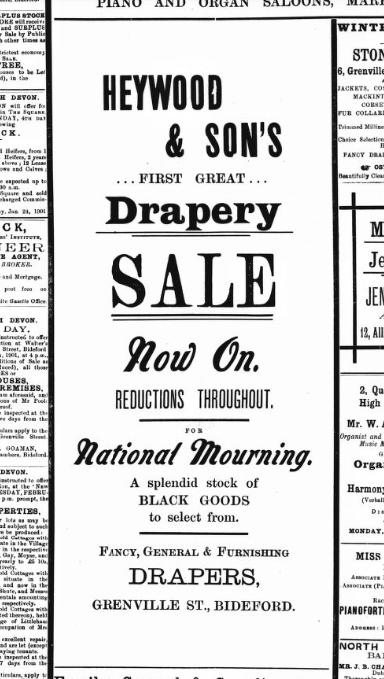
Heywood & Son's
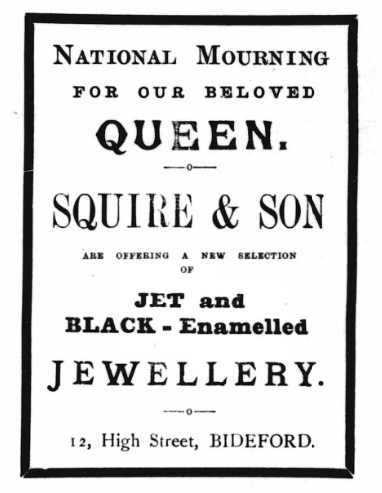
Squire & Son
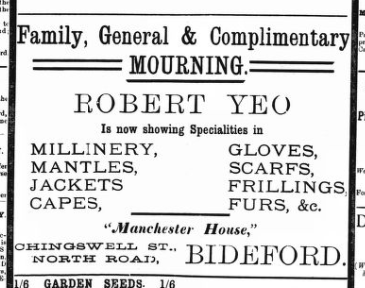
Robert Yeo
The Bideford Weekley Gazette and Devon and Cornwall Advertiser, Tuesday, January 29, 1901 - “On Sunday morning a special service in memory of the Queen was held in Lavington Chapel. The pulpit and Choir gallery were draped in black, relieved with white ribbon and lilies, and at the front of the pulpit a crown and cross wrought in white lilies was suspended. The effect was chaste. Rev E Roberts conducted the earlier portion of the service, and his prayer was comprehensive, and appropriate. The choir sang special hymns and the anthem. Rev George Warren delivered the memorial address which dealt with the loyalty of Queen Victoria.”
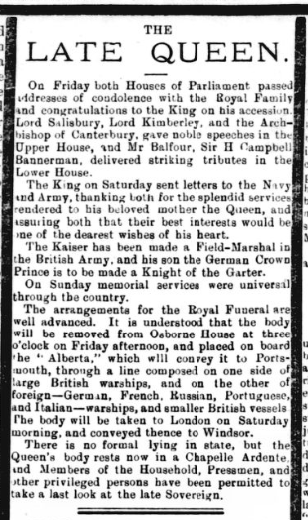
Condolences
“Bideford Postmistress and Staff sent a message condoling with the King and Royal Family.
The Mayor of Bideford on Tuesday evening sent a telegram of condolence to the King, and on Wednesday received a message of thanks from the Equerry to the Prince of Wales.
Bideford School Board, and Northam Urban District Council have passed resolutions expressing regret at the death of the Queen, and sympathy with the Royal Family.
Immediately on receipt of the news of the death of the Queen, the Mayor of Bideford (Mr T Goaman, J.P.) sent a telegram to the King on behalf of the town, expressing “deepest sorrow at the loss of our beloved Queen, and humbly tendering very deepest sympathy to the members of the Royal Family.” On Wednesday a reply was received as follows: “The Prince of Wales desires me to thank you and Corporation of Bideford for your kind expression of sympathy. Equerry.”
Church services
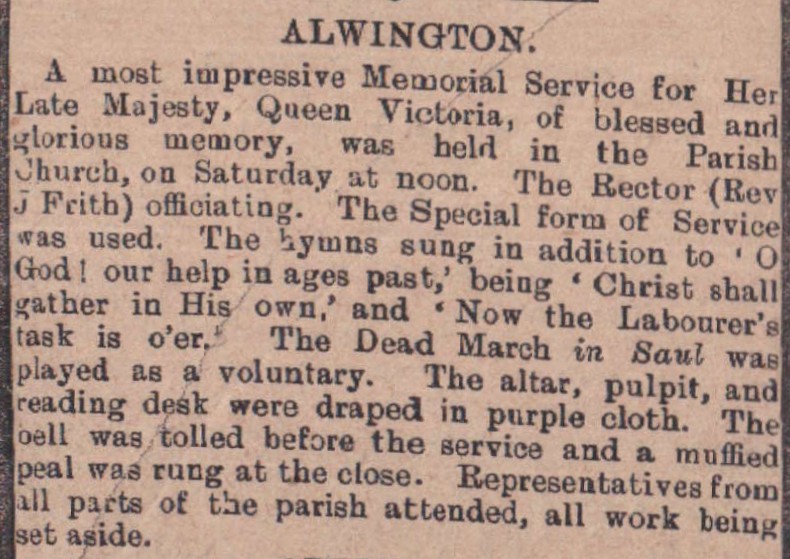
At Alwington - “The sorrowful news of Her Majesty’s death was received here with profound manifestations of regret, muffled peals were rung from the old Church tower and flags were flown at half-mast. On Sunday morning Rev J B Nowell conducted a Memorial Service in the Wesleyan Church. Two of the Queen’s favourite hymns were sung. The pulpit was draped in black. “
The following week, at Alwington …
Appledore - "For the past week the town generally has been in a state of mourning for the late Queen. On Saturday all shopkeepers and tradesmen closed their places of business and the public houses were closed from 11am to 4pm. The Church bell commenced to toll at 9.30am. At 11 o'clock the Town Band met, and at different parts of the town played the 'Dead March in Saul', the groups of onlookers standing reverently the while. At 2pm a memorial service was held at St Mary's Church."
At Buckland Brewer – “A muffled peal was rung on the Church bells on receipt news at the Queen’s death. The Parish Church was draped in black on Sunday, and at each of the three services allusion was made to the great blow which had fallen upon the nation. The Vicar announced the accession of King Edward VII, and the National Anthem was sung. The Dead March was played at the end of the service, the congregation then joining in silent prayer for King and Country.
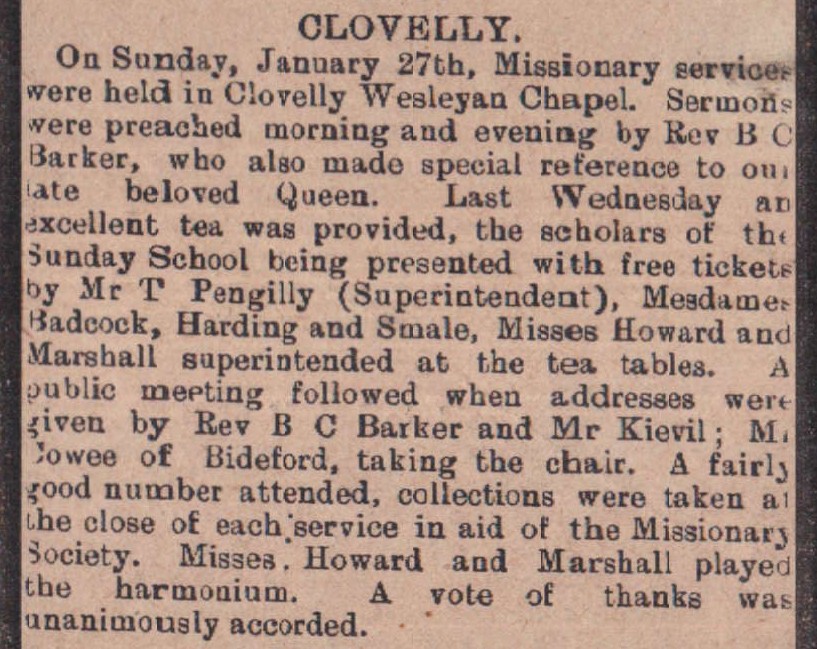
Clovelly
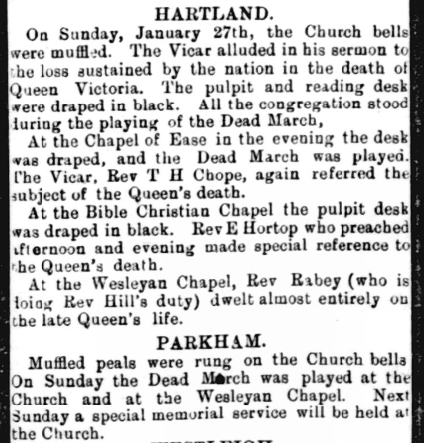
Hartland and Parkham
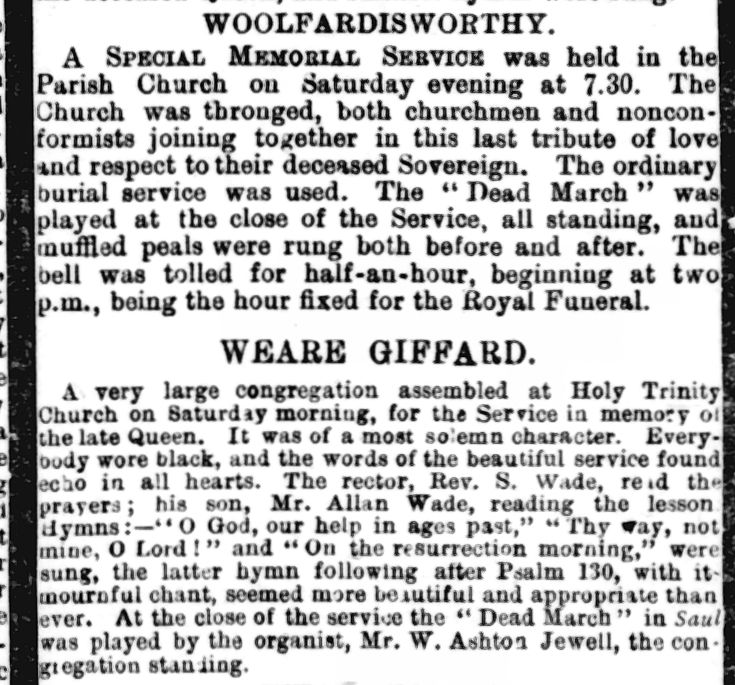
Woolsery and Weare Giffard
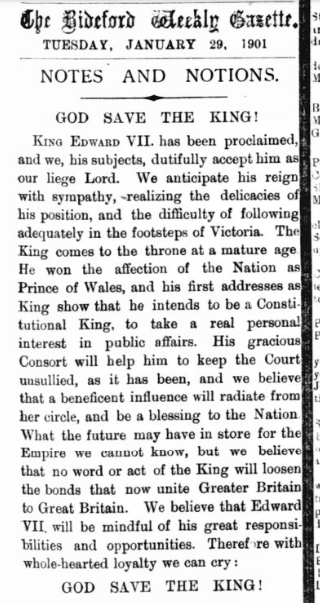
God Save the King!
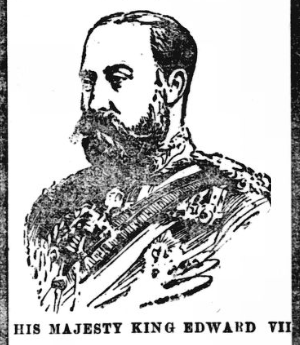
The Bideford Weekley Gazette and Devon and Cornwall Advertiser - "The King has been pleased to direct that Saturday next, the 2nd February, be observed as a day of general mourning, and that banks be closed and business suspended under the provisions of the Act, 34 Victoria, Chapter 17. An Order in Council has been issued to proclaim his Majesty's commands."
Funeral arrangements in London
"The outer coffin and leaden shell which will enclose the body of the dead Monarch were despatched from London on Tuesday morning, and reached Osborne in the course of the day. The outer casket is of panelled polished oak. An inscription appears both on the leaden shell and on the oak coffin. The inscription in each case is the same, but for the shell a silver plate has been used, while the inscription appears on an almost square brass plate on the coffin."
The Bideford Weekley Gazette and Devon and Cornwall Advertiser, Tuesday, February 5, 1901 - “On Monday afternoon a meeting of high officials who will be concerned in the funeral arrangements was held at the temporary offices of the Earl Marshal at Westminster, and lasted for close on two hours. At the conclusion of the conference the Deputy Garter King at Arms made the following announcements on behalf of the Duke of Norfolk: “The arrangements for carrying the heavy coffin containing the body of the late Queen on the arrival of the funeral train in London have been entrusted to Lieutenant Lewlie Hamilton, of the Coldstream Guards, and Lieutenant E Seymour, of the Grenadier Guards, and the non-commissioned officers who are to have the honour of acting as bearers upon this historic occasion have been selected by the commanding officers of the various regiments of the Guards. All are men of the very best character, of spotless records, and of superb physique. Not one of them is less that six feet in height. The following is a complete list:
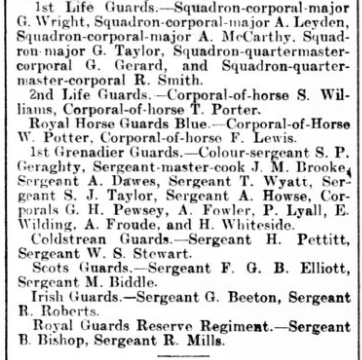
The bearers
"It has been arranged that the Queen's body shall arrive at Victoria Station, London, from Osborne, at eleven o'clock on Saturday morning. There will be an extended route to Paddington, which is expected to be reached at one o'clock, and after the funeral service in St George's Chapel, Windsor, the coffin will rest there temporarily, being subsequently deposited in the Frogmore Mausoleum."
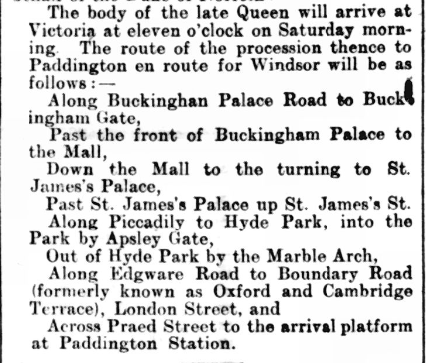
Funeral procession
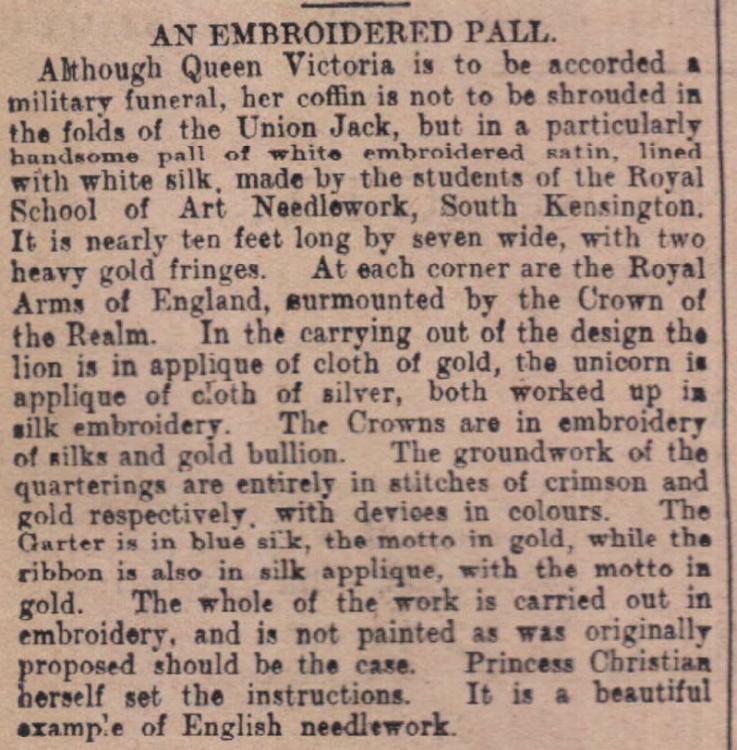
"In reply to the Lord Mayor of London his Majesty's Office of Works state that all hangings of drapery on the occasion of her Majesty's funeral are to be of purple colour, and not of black, by order of the King."
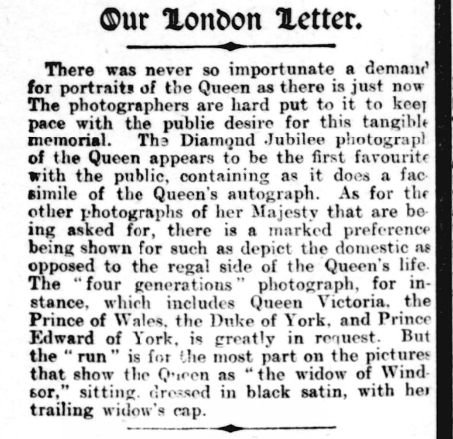
Demand for photographs
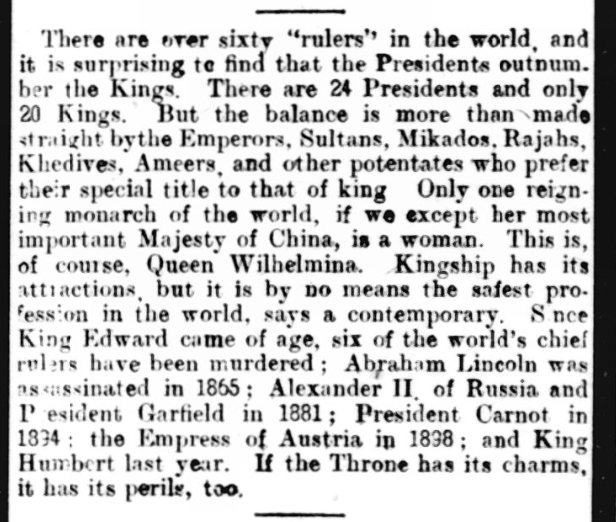
Sixty rulers
The Bideford Weekley Gazette and Devon and Cornwall Advertiser, Tuesday, February 12, 1901 - “The Northam District Council has given permission to Captain Blakeney, R.N., to add to the Diamond Jubilee Memorial on Bone Hill, a stone for each yar of Queen Victoria’s reign since 1897, one to be a broken stone, inscribed: ‘Queen Victoria died 22nd January, 1901.’ Captain Blakeny, it will be remembered, was the originator of the Memorial.”